Itel Reding
William TellItel Reding is the old Landamman whom the assembled Confederates recognize as their worthiest leader. At a moment when they must decide whether to continue seeking redress or resist their oppressors, he gives the gathering a formal center: he steps forward to swear with them, asks whether gentler means have been exhausted, and counsels patience while events unfold. His role is less that of a battlefield hero than of a civic leader trying to make collective action answerable to law, consent, and circumstance.
Identity and Public Authority
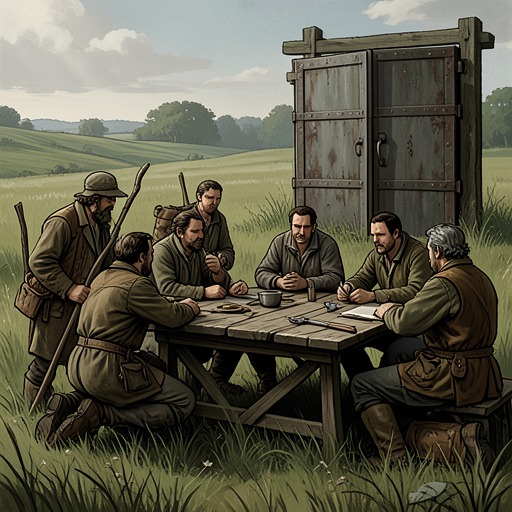
Reding is identified in the assembly as the old Landamman, an established public figure whose standing is made explicit when Stauffacher asks whether he is present and whether anyone more worthy could be found. The question places authority in the community’s judgment rather than in a ruler’s appointment. When the people raise their right hands in agreement, Reding steps into the centre, visibly taking up the role they have offered him.
His authority is grounded in both office and trust. The assembly does not merely appeal to his title: it selects him at a decisive moment of shared deliberation. Reding’s appearance at the centre transforms a scattered gathering into a body capable of acting together, while his subsequent interventions show that leadership means managing the decision as well as embodying it.
The Oath and the Assembly
Reding cannot lay his hands upon the books when he begins his oath. Instead, he swears by the everlasting stars. The substitution gives the scene a striking public solemnity: the oath is not suspended for want of a prescribed object, but made before a witness represented as enduring and beyond human authority. Reding’s gesture binds his own word to the assembly’s commitment at the instant he assumes its leadership.
The political debate around this oath concerns the Confederates’ place within the Empire. They recall having freely sought imperial protection, while the discussion also recognizes that even free people may have a feudal lord and may owe him aid in war. These claims distinguish acknowledged, traditional obligations from the arbitrary rule they now suffer. Reding’s leadership therefore emerges within a dispute about what legitimate authority is: the gathering is not presented simply as rejecting every bond, but as weighing the limits of its obligations against the preservation of its rights.
Deliberation and Resistance
As the assembly turns from argument toward action, Reding asks the Confederates whether all gentler means have been tried. He allows for the possibility that the emperor may not know of their wrongs, keeping open the distinction between imperial authority and the conduct of the oppressors. The question makes resistance a decision reached after considering another remedy, not an impulse that needs no account of its cause.
The gathering’s proposed course is to shake off the hated subjection and preserve its ancient rights. Its members also declare a limit: they will do what necessity requires, but no more, and will drive out the tyrants and their agents. Reding does not deliver those particular formulations, but his role in the deliberation gives them a setting in which the proposed resistance is discussed collectively and in terms of necessity and right.
After one speaker offers to pledge himself for his country and says that his honor is cleared and his heart at rest, Reding answers that counsel will come with circumstance. He asks the others to be patient and to trust to the moment. The reply does not settle the plan; it refuses to pretend that every detail can be settled in advance. Reding’s political judgment rests instead on readiness to decide when circumstances make the next step clear.
Change and Narrative Role
Reding’s movement is from recognized elder to active presiding leader. The raised hands establish the assembly’s consent; the oath gives that consent a solemn form; his questions then guide the transition from considering remedies to accepting that resistance may be necessary. His caution does not cancel resolve. It helps distinguish a deliberate common decision from rash action, even as the assembly approaches a course that will overturn the existing order.
The wider outcome gives the deliberation a concrete political horizon. Later, the people attack the building associated with their oppressors, and the cap once used as an instrument of despotic power is preserved as a lasting symbol of freedom. Those later actions are not Reding’s individual deeds, but they clarify the stakes of the public judgment he helped lead: authority is being reclaimed by a community acting together, and an object of compelled submission can be made to signify its opposite. Reding’s significance lies in giving that collective turn a language of oath, consent, restraint, and timing.